
Disc Bulge Treatment Adelaide
Back Pain Physiotherapy St Marys
Back pain from a disc bulge can be debilitating — whether it stops you sitting at your desk, picking up your kids or getting back on the field. The good news is that most disc bulges respond very well to physiotherapy, and surgery is far less commonly needed than people expect. Our experienced team will get to the cause of your pain and build a plan to get you moving again.
disc bulge Treatment in Adelaide
What Is a Disc Bulge?
The discs in your spine act as shock absorbers between each vertebra. Each disc has a tough outer ring and a soft gel-like centre. A disc bulge — also called a disc herniation or prolapsed disc — occurs when the outer ring weakens or tears, allowing the inner material to push outward and press on nearby nerves or spinal structures.
This is most common in the lumbar spine (lower back), though it can also occur in the cervical spine (neck). Disc bulges range in severity, and the right management depends on which type you have, where it is and what symptoms it is producing.
Importantly, a disc bulge on a scan does not automatically mean surgery or permanent damage. Research consistently shows that disc bulges can reduce in size over time with conservative management — and that many people with bulges on imaging have no pain at all. What matters most is how the disc is behaving clinically, not just what the scan shows.
Who Does It Affect?
- Office workers and people in sedentary roles — prolonged sitting increases disc pressure significantly
- Tradies, nurses and manual handling workers — repeated lifting, bending and twisting
- Athletes in contact sport, weightlifting, rowing and gymnastics
- Runners and cyclists, particularly with sudden training load spikes
- People with sudden onset back pain following a lift, sneeze or awkward movement
- Those with gradually worsening back and leg pain over weeks or months
- People in their 30s to 50s — though disc bulges can occur at any age
Common Symptoms of a Disc Bulge
- Central or one-sided lower back pain, often worse with sitting or bending forward
- Pain, tingling or numbness radiating into the buttock, thigh, calf or foot (sciatica)
- Symptoms that worsen with prolonged sitting, coughing or sneezing
- Pain that eases with walking or lying in a supported position
- Weakness in the leg, foot or toes in more significant nerve compression
- Stiffness and difficulty changing position — getting up from a chair or out of bed
- Muscle spasm through the lower back or buttock
- In cervical disc bulges — neck pain with referral into the arm, hand or fingers
Pain travelling down the leg below the knee often indicates nerve root irritation — this changes both the assessment approach and the treatment plan.
What Can Contribute to a Disc Bulge?
A disc bulge rarely happens in isolation. Understanding the contributors is essential to treating the cause, not just the symptoms.
What most people don't realise is worsening their pain:
- Prolonged sitting — increases disc pressure more than almost any other position; hours at a desk or in a car without movement is one of the most common and overlooked aggravating factors
- Poor movement habits — repeatedly bending from the spine rather than the hips during lifting and daily tasks places cumulative stress on the disc
- Weak deep stabilisers — when the deep core and gluteal muscles are not functioning well, the disc absorbs forces it was not designed to handle
- Tight hip flexors and hamstrings — reduced hip mobility forces the lumbar spine to compensate, increasing disc load
- Sudden load spikes — a heavy lift, awkward twist or new exercise programme introduced too quickly can push an already stressed disc past its tolerance
- Stress and poor sleep — both increase pain sensitivity and slow recovery, and are frequently overlooked as genuine contributors
How Physiotherapy Can Help
- Assessment
Our assessment covers the specific level and direction of disc involvement, neurological signs, movement patterns and contributing factors from your work, home and sporting environment. This shapes a treatment plan that is precise — not generic.
- Hands-On Treatment
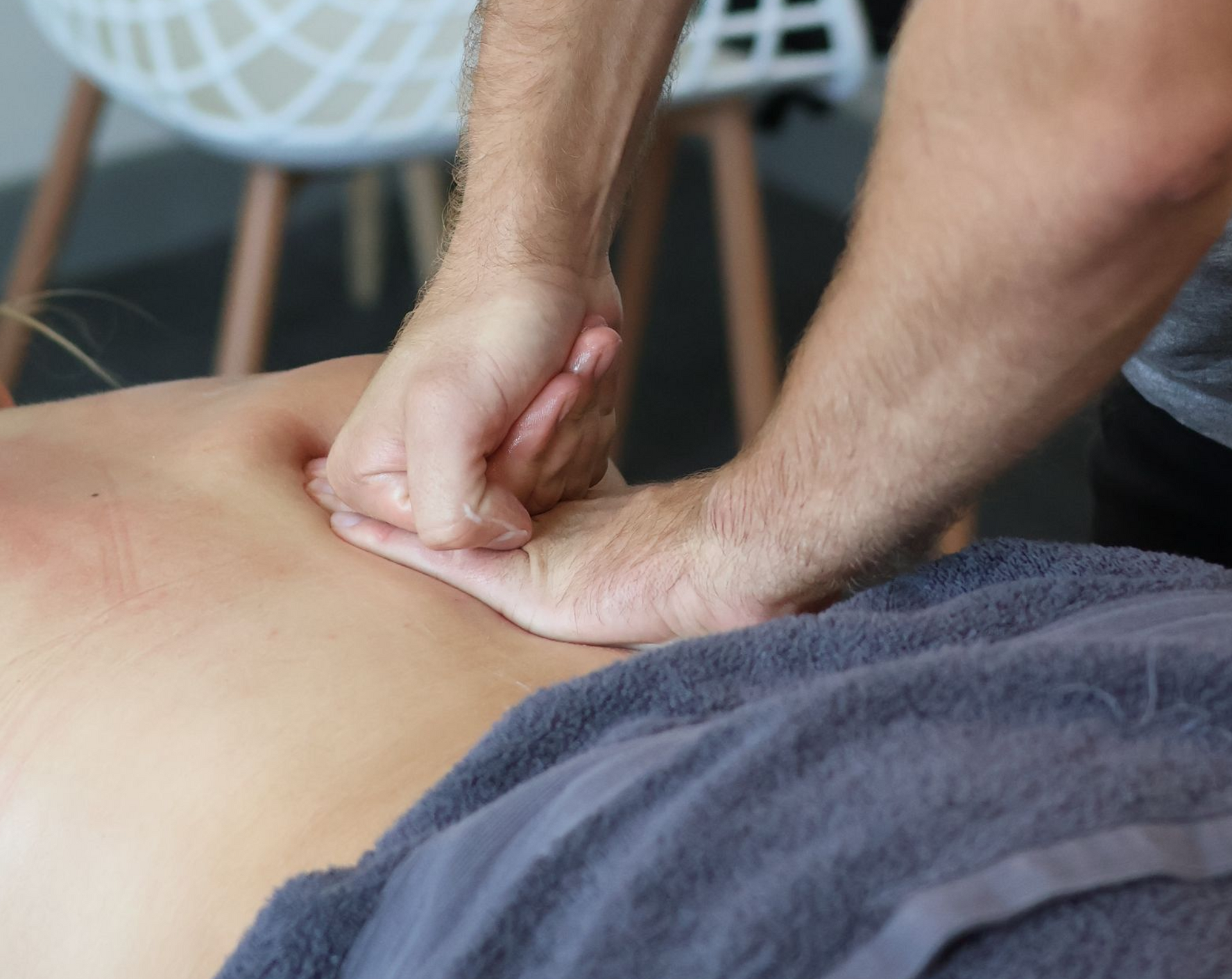
Hands-on treatment begins from your very first appointment. We use manual therapy and soft tissue techniques to reduce pain, restore movement and take load off the irritated disc from day one. This may include:
- Joint mobilisation — gentle, targeted spinal movement to restore range of motion and reduce pain without provoking the disc
- Myofascial release and cupping — releasing the deep spinal muscles and gluteals that go into protective spasm around an irritated disc and perpetuate pain long after the acute phase
- Trigger point therapy — addressing referral patterns in the lumbar paraspinals, gluteus medius and piriformis
- Dry needling and electro dry needling — reducing neural sensitivity, easing muscle guarding and improving tissue extensibility around the affected disc level
- Load Management
Too much load too soon re-irritates the disc; too little delays recovery. We guide you through a structured modification of daily activities, work tasks and training — identifying what to temporarily adjust and progressively reintroducing load as symptoms settle.
- Rehabilitation Exercises
Exercise rehabilitation is carefully sequenced — jumping into generic core exercises too early is a common mistake. Our programme progresses through three phases:
- Early phase — pain relief, neural mobilisation (nerve flossing) and deep core activation
- Middle phase — lumbar mobility, hip hinge and gluteal strengthening, single-leg stability
- Late phase — sport and task-specific loading, return to lifting and rotational movements, building long-term resilience
-
Other Services That Can Help
At Active Balance, your physiotherapist, myotherapist and exercise rehabilitation clinician work together under one roof — communicating directly and coordinating your care so every session builds on the last.
- Massage Therapy helps reduce the muscle guarding and protective tension that builds around disc injuries — improving comfort and movement between physiotherapy sessions.
- Myotherapy brings targeted soft tissue work including deep tissue techniques, dry needling and cupping to address the chronic muscle holding patterns that develop around disc injuries and contribute to referred pain.
- Supervised Exercise & Rehab Gym allows your rehabilitation to be progressed under direct clinician supervision — with correct technique, appropriate load and real-time feedback. Particularly valuable for anyone returning to heavy lifting, a physical occupation or sport.
- Recovery Services — including compression therapy and heat and cold modalities — support tissue recovery between sessions and help manage flare-ups during rehabilitation.
Do I Need a Scan?
Not necessarily — and not always at the start. Most disc bulge presentations can be assessed and treated clinically without imaging.
Scans are recommended when there are progressive neurological signs, symptoms not improving as expected, or red flag features requiring medical review. When imaging is needed, we will communicate directly with your GP to arrange it.
When Should I Seek Further Medical Advice?
Seek urgent medical attention if you experience:
- Loss of bladder or bowel control, or difficulty urinating — call 000 or go to emergency immediately
- Numbness or tingling in the inner thighs, groin or perianal area (saddle anaesthesia)
- Progressive weakness in both legs
- Back pain following significant trauma — fall from height or motor vehicle accident
- Unexplained weight loss, fever or night sweats alongside back pain
- Back pain in someone with a history of cancer
These features may indicate cauda equina syndrome or another serious spinal condition requiring emergency assessment, not physiotherapy.
Could It Be Something Else?
Disc bulge shares symptoms with several other conditions, making an accurate diagnosis essential:
- Facet joint dysfunction — worse with extension and rotation rather than flexion; often confused with disc pain
- Piriformis syndrome — can compress the sciatic nerve, producing leg pain that mimics disc-related sciatica
- Sacroiliac joint (SIJ) dysfunction — refers pain into the buttock and leg in a pattern similar to disc referral
- Spinal stenosis — canal narrowing producing leg symptoms, typically in older adults; worse with walking, relieved by sitting
- Referred pain from hip pathology — can refer into the groin, thigh and buttock in a pattern easily confused with lumbar disc symptoms
Return to Activity & Prognosis
The prognosis for disc bulge with appropriate physiotherapy management is genuinely good. Most people with an acute disc bulge notice meaningful improvement within 4–8 weeks. Full recovery — including return to sport or a physical occupation — typically takes 3–6 months depending on severity and consistency with rehabilitation.
Return to activity is graduated and guided by your symptom response. We will give you clear milestones and honest timelines — and the goal is not just getting you out of pain, but building a back that is strong enough to handle whatever you want to do long term.
Why Choose Active Balance Physio & Wellness?
Physio-led integrated care
Physio, massage, myo & rehab under one roof
Individualised treatment plans
Friendly, caring team focused on results
Convenient Adelaide location
After-hours appointments available
Frequently Asked Questions
- Is a disc bulge the same as a slipped disc? "Slipped disc" is a colloquial term for a disc herniation or bulge. Discs do not actually slip — they bulge or herniate when the outer fibres weaken and inner material pushes outward.
- Does a disc bulge mean I need surgery? In the vast majority of cases, no. Surgery is considered only when conservative management has been thoroughly trialled without improvement, or when there are progressive neurological signs. Most people — including those with significant sciatica — recover well with physiotherapy.
- Can I exercise with a disc bulge? Yes — and in most cases, you should. The type and intensity needs to be carefully selected based on your presentation, as some movements that are helpful later in recovery can be provocative early on. Your physiotherapist will prescribe a safe, specific programme for where you are right now.
- What is the difference between a disc bulge and sciatica? Sciatica is a symptom — pain, tingling or numbness radiating down the leg. A disc bulge is one of several causes of sciatica, alongside piriformis syndrome, spinal stenosis and SIJ dysfunction. An accurate diagnosis is essential to make sure you are treating the right cause.
- Can stress make a disc bulge worse? Yes. Psychological stress increases central sensitisation, which amplifies pain from an already irritated disc. Sleep, stress and overall load on the system are legitimate — and frequently overlooked — parts of disc bulge management.
- How do I know if my back pain is from a disc or something else? Disc pain tends to be worse with sitting, bending forward, coughing or sneezing, and may radiate into the leg. Facet joint pain is often worse with standing and extension. SIJ pain tends to be one-sided around the lower back dimples. A thorough physiotherapy assessment is the most reliable way to distinguish between them.
✅Private Health Rebates
✅Same Week Appointments
✅Experienced Team
✅Onsite Parking
Don't put up with back pain. Book with our team today for a thorough assessment and an integrated recovery plan — so you can get back to work, sport and life without the guesswork.