
Golfer's Elbow Treatment Adelaide
Elbow Pain Physiotherapy St Marys
Pain on the inside of your elbow that won't go away? Whether it came on during a round of golf, after months of heavy lifting, or gradually through repetitive work, golfer's elbow is a stubborn condition that rarely resolves on its own without the right treatment.
At Active Balance, we treat golfer's elbow with a combination of hands-on therapy and a structured loading program, addressing both the symptoms and the underlying cause so you can get back to doing what you love.
golfer's elbow Treatment in Adelaide
What Is Golfer's Elbow?
Golfer's elbow (medically known as medial epicondylalgia or medial epicondylitis) is a painful condition affecting the tendons that attach to the medial epicondyle, the bony bump on the inside of the elbow. These tendons belong to the forearm flexor and pronator muscles — the muscles responsible for gripping, wrist flexion, and forearm rotation.
Despite the name, the majority of people who develop golfer's elbow have never swung a golf club in their life. It is fundamentally a tendon overload condition — the result of repetitive or excessive stress on the medial tendons that exceeds the tendon's capacity to recover.
The underlying pathology is not primarily inflammatory (despite the "-itis" suffix commonly used). Research has shown that chronic golfer's elbow involves tendon degeneration — a process called tendinosis — where the normal tendon structure breaks down and fails to heal properly. This is an important distinction because it influences how the condition is best treated.
Who does Golfer's Elbow Affect?
Golfer's elbow is more common than many people realise, affecting around 1–3% of the general population. It tends to peak in adults between the ages of 40 and 60, though it can affect people of any age who perform repetitive forearm and grip-intensive activities.
It is particularly common in:
- Manual workers & tradies (anyone performing repetitive gripping, hammering, or tool use)
- Office workers and desk workers (prolonged keyboard and mouse use)
- Golfers (poor swing mechanics or gripping)
- Racquet sport players - tennis, squash, badminton etc
- Gym-goers and weightlifters (heavy pulling movements, rows, or curls with poor technique or excessive load)
- Climbers
- Musicians
Golfer's elbow generally affects men and women roughly equally. It is more common in the dominant arm, but can occur in both sides.
What Causes Golfer's Elbow?
Risk Factors & Contributing Factors
- Repetitive gripping and forearm activity — particularly in occupational settings
- A sudden spike in training load or returning to activity after a break
- Poor technique in sport, gym training, or manual tasks
- Equipment factors — grip size, racquet weight, tool vibration
- Weakness in the forearm, wrist, or shoulder musculature
- Age-related tendon changes reducing resilience and recovery
- General health factors — smoking, diabetes, and obesity are associated with slower tendon recovery
Symptoms & Signs of Golfer's Elbow
- Pain and tenderness on the inside of the elbow — often a deep ache or burning sensation
- Pain with gripping — shaking hands, carrying bags, opening jars, or using tools
- Weakness in grip strength
- Morning stiffness that eases with gentle movement
- Pain radiating down the inner forearm toward the wrist
- Symptoms that flare after activity and ease with rest — then gradually stop settling as the condition progresses
How Physiotherapy Can Help Golfer's Elbow
Physiotherapy is a very effective treatment for golfer's elbow, combining hands-on pain relief with progressive strength rehabilitation.
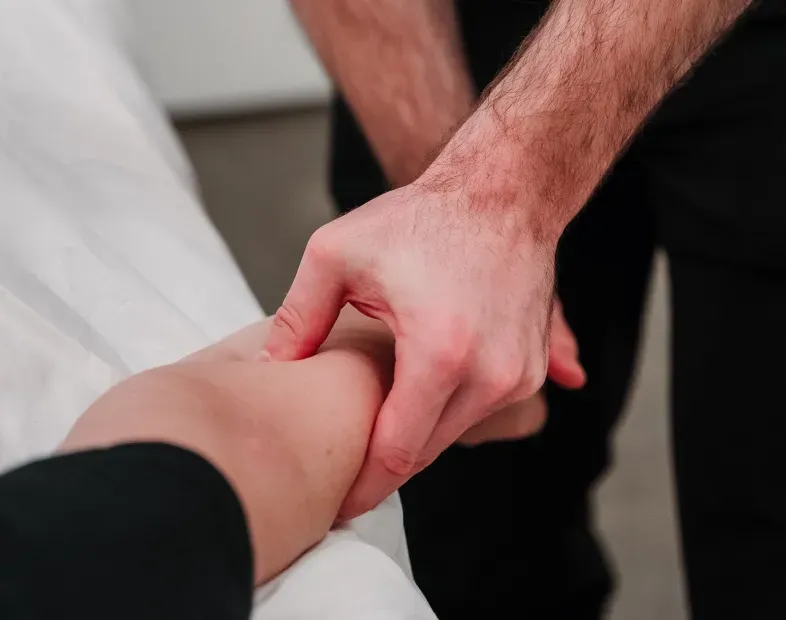
Hands-on treatment is the priority in the early stages. Your physio will use a combination of joint mobilisation, dry needling, and soft tissue techniques to reduce pain, ease forearm tension, and restore movement — getting you comfortable enough to engage effectively with the strengthening phase.
Load management runs alongside hands-on treatment from the start. We identify what's driving your symptoms — training load, technique, equipment, or underlying weakness — and help you modify activity so the tendon can settle without deconditioned further.
Bracing & strapping can play a useful short-term role in managing symptoms during daily tasks and sport. A counterforce brace or epicondyle strap worn during activity helps offload the medial tendon and reduce pain while your strengthening program takes effect. Your physio will advise whether bracing is appropriate, how to use it correctly, and when to wean off it — it's a pain management tool, not a long-term fix.
Progressive tendon loading is the cornerstone of long-term recovery. We build a carefully staged strengthening program that starts with isometric exercises for early pain relief, then advances through isotonic and functional loading as your tendon adapts and capacity increases. This is the phase most people miss — and the most important one.
Technique & biomechanical correction addresses the root cause. Where relevant we assess your swing mechanics, lifting technique, grip, or workstation setup and make adjustments that reduce tendon stress and prevent recurrence.
How Massage & Myotherapy Can Help
Remedial massage and myotherapy are a valuable complement to physiotherapy for golfer's elbow. Targeted soft tissue work to the forearm flexors reduces muscle tension, improves circulation to the tendon, and decreases the compressive load at the medial epicondyle.
Trigger point therapy to the forearm, upper arm, and shoulder can significantly reduce referred pain and improve grip comfort. Cupping to the forearm and upper arm is also effective for decompressing tight soft tissues and improving local blood flow.
Our massage and myotherapy team works closely with your physio to make sure treatment is coordinated across both disciplines at every stage of your recovery.
When to Seek Further Medical Advice
Golfer's elbow is generally a benign condition that responds well to physiotherapy. However, some symptoms warrant prompt medical attention rather than physiotherapy alone:
- Numbness, tingling, or weakness in the ring or little fingers — may indicate ulnar nerve involvement requiring specific assessment and management
- Significant swelling, bruising, or deformity after a fall or impact — may indicate a fracture or significant ligament injury requiring imaging
- Locking or catching in the elbow joint — can indicate loose bodies or structural pathology requiring specialist review
- Constant, severe pain that is unrelated to activity or movement — should be investigated to rule out other causes
- Night pain that wakes you from sleep — particularly if accompanied by unexplained weight loss, fatigue, or feeling generally unwell
- No meaningful improvement after six to eight weeks of consistent physiotherapy — warrants further investigation including imaging and possible specialist referral
- If any of these apply, we will identify them at your initial assessment and refer you to the appropriate medical professional promptly.
Progosis
Golfer's elbow generally has an excellent prognosis with the right management. Most people recover fully and return to all previous activities including sport and heavy manual work.
- Mild cases — four to eight weeks
- Moderate cases — eight to sixteen weeks
- Chronic or long-standing cases — six to twelve months
The biggest predictor of a poor outcome is relying on passive treatment alone without a progressive loading program. Recurrence is common when the underlying contributing factors — load, technique, and strength — aren't properly addressed as part of rehabilitation.
Why Choose Active Balance Physio & Wellness?
Physio-led integrated care
Physio, massage, myo & rehab under one roof
Individualised treatment plans
Friendly, caring team focused on results
Convenient Adelaide location
After-hours appointments available
Frequently Asked Questions
Q: How is golfer's elbow different from tennis elbow? Golfer's elbow affects the inside of the elbow, tennis elbow affects the outside. Both are tendon overload conditions managed with the same principles — hands-on pain relief, progressive loading, and activity modification.
Q: Should I rest completely? Complete rest is rarely the right answer and allows the tendon to further decondition. The goal is finding the right level of activity that doesn't aggravate symptoms while your strengthening program takes effect. Your physio will guide you on what to continue, modify, and avoid.
Q: Will a cortisone injection fix it? A cortisone injection may provide short-term relief but doesn't address the underlying tendon degeneration. Evidence suggests repeated injections can impair long-term healing. If you've had one, use the pain relief window to engage with your loading program — that's where lasting recovery comes from.
Q: Do I need a scan? Usually not — golfer's elbow is a clinical diagnosis. Ultrasound may be recommended if the diagnosis is uncertain or symptoms aren't responding as expected, but imaging findings don't always correlate with symptoms or severity.
Q: I've had it for over a year — is it too late for physio? Not at all. Chronic golfer's elbow responds very well to a structured loading program even after years of symptoms. Many people who haven't improved with previous treatment simply haven't had the benefit of a properly progressive, evidence-based approach.
✅Private Health Rebates
✅Same Week Appointments
✅Experienced Team
✅Onsite Parking
Ready to Get Your Elbow Sorted?
Don't let golfer's elbow drag on. With the right hands-on treatment and a structured strengthening program, full recovery is absolutely achievable. Book an appointment with our experienced physiotherapy team today.