
Hip Impingement Treatment Adelaide
Hip Pain Physiotherapy St Marys
Deep groin pain, a catching sensation in your hip, or stiffness that just won't budge? Hip impingement (AKA femoroacetabular impingement or FAI) is one of the most commonly missed causes of hip and groin pain, particularly in active adults and athletes.
At Active Balance we combine hands-on treatment to reduce pain and restore movement with a targeted strengthening program to offload the hip joint and get you back to doing what you love.
hip impingement Treatment in Adelaide
What Is Hip Impingement (FAI)?
Femoroacetabular impingement (FAI) occurs when there is abnormal contact between the ball (femoral head) and socket (acetabulum) of the hip joint during movement. This contact causes pinching of the soft tissues, including the labrum and joint cartilage, leading to pain, stiffness, and over time, potential structural damage if left unmanaged.
FAI is classified into three types:
- Cam impingement — an abnormal bony prominence on the femoral head that causes it to jam into the socket during movement. More common in men and in athletes who played high-impact sport during adolescence.
- Pincer impingement — excess bone on the rim of the acetabulum (socket) that causes the femoral neck to butt up against the socket wall. More common in middle-aged women.
- Combined impingement — features of both cam and pincer, which is actually the most common presentation seen clinically.
It's important to note that bony changes associated with FAI are extremely common on imaging — many people have them with no symptoms at all. The presence of FAI on a scan does not automatically mean it is the source of your pain, which is why thorough clinical assessment matters more than imaging alone.
Who does it Affect?
FAI is most commonly diagnosed in active adults between the ages of 20 and 50, though it can affect people across a wide age range. It is particularly prevalent in:
- Athletes involved in sports requiring repetitive hip flexion and rotation, such as football, basketball, hockey, dancing, martial arts, and cycling
- Former youth athletes who played high-impact sport during their growth years
- Active adults who have noticed gradual onset groin or hip pain with exercise
- People in physically demanding occupations requiring repeated squatting, bending, or lifting
FAI is increasingly recognised in the general population as imaging technology improves — it is far more common than previously understood.
Contributing Factors & Causes
- Bony morphology — the shape of the hip joint is largely determined during growth and adolescence, and cam-type FAI in particular is strongly associated with high-impact sport during this period
- Hip muscle weakness — particularly the hip abductors, deep hip rotators, and gluteal muscles, which when weak increase the stress placed on the joint during movement
- Poor movement control and motor patterns — faulty hip and lumbar movement strategies increase impingement forces during everyday and sporting activities
- Repetitive end-range hip loading — activities that repeatedly drive the hip into positions of provocation
- Hypermobility — excessive joint mobility can increase the range into which impingement occurs
- Previous hip injury or surgery — altering joint mechanics and load distribution
Symptoms & Signs
- Deep groin pain — the most classic presentation, often described as a catching, pinching, or aching sensation
- Pain at the front of the hip or deep in the buttock
- Stiffness and reduced range of motion — particularly with hip flexion, internal rotation, and squatting
- A catching, clicking, or locking sensation in the hip with certain movements
- Pain that worsens with prolonged sitting, getting in and out of a car, squatting, or pivoting
- Symptoms that increase with higher activity levels and settle with rest in the early stages
- In more advanced cases, pain that becomes more persistent and less activity-dependent
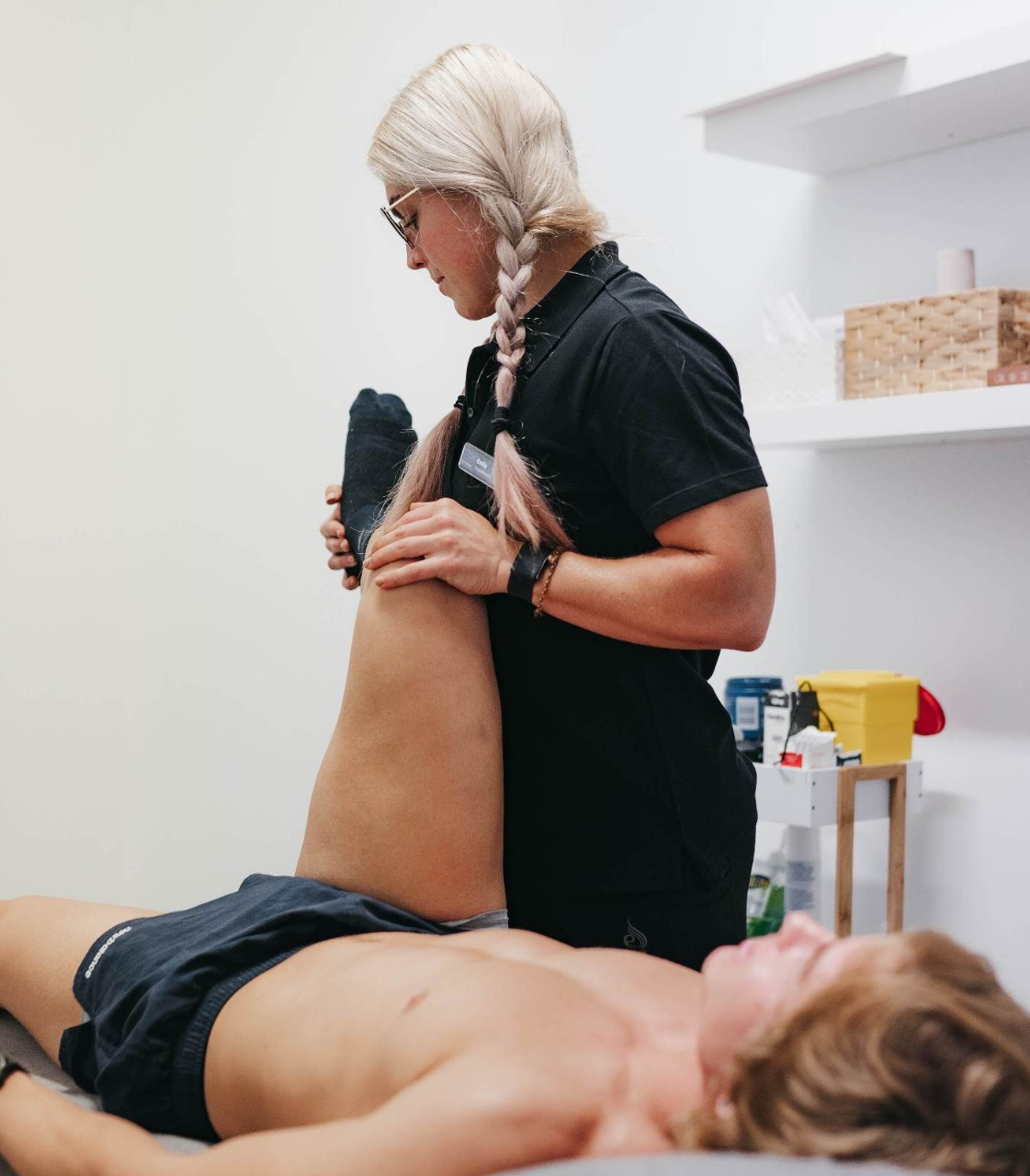
How Physiotherapy Can Help Hip Impingement
Physiotherapy is often the first-line treatment for FAI and is highly effective for the majority of people — many of whom avoid surgery entirely with a well-structured conservative program.
Hands-on treatment in the early stages focuses on reducing pain, improving hip joint mobility, and addressing soft tissue restrictions around the hip, gluteal region, and lumbar spine. Joint mobilisation, dry needling, and soft tissue techniques are used to restore comfortable movement and prepare the hip for loading.
Load management is established early. We identify which activities and movement patterns are provoking your symptoms and help you modify these while keeping you as active as possible. Avoiding all activity is rarely necessary or helpful.
Bracing & strapping is less commonly used for FAI than for other conditions, but taping techniques to support hip positioning and reduce impingement during specific activities can be useful in some presentations — particularly in the early stages of rehabilitation.
Progressive hip strengthening is the cornerstone of FAI management. Building strength through the gluteals, deep hip rotators, and hip abductors reduces the compressive load on the joint and improves the control of femoral head movement within the socket. We progress loading carefully from basic activation work through to sport-specific and functional demands.
Movement retraining addresses the way you squat, hinge, run, and perform sport-specific movements. Correcting faulty motor patterns that drive impingement forces is essential to long-term symptom management and preventing recurrence.
How Massage & Myotherapy Can Help
The hip flexors, gluteals, deep hip rotators, and lumbar musculature all commonly develop significant tension and trigger points in response to FAI — both as a cause and consequence of altered movement patterns. Remedial massage and myotherapy targeting these areas can meaningfully reduce pain, improve hip mobility, and restore more normal movement mechanics.
Cupping to the gluteal and hip flexor region is particularly effective for releasing deep tissue tension that is difficult to address with standard massage techniques. Trigger point therapy to the TFL, piriformis, and iliopsoas can also provide significant relief for people whose hip pain has a strong muscular component.
Our massage and myotherapy team coordinates closely with your physio to ensure soft tissue work directly supports your rehabilitation program at every stage.
When to Seek Further Medical Advice
FAI is generally manageable with physiotherapy, but some presentations require prompt medical review:
- Sudden severe hip pain after a fall or impact — possible fracture or significant soft tissue injury requiring imaging
- Locking of the hip joint — may indicate a loose body or significant labral tear requiring specialist assessment
- Significant groin pain in a child or adolescent — should always be assessed medically to rule out conditions such as Perthes disease or slipped capital femoral epiphysis
- Constant, severe pain unrelated to activity — particularly if accompanied by night pain, unexplained weight loss, or feeling generally unwell
- Symptoms that are worsening despite consistent, well-managed physiotherapy over eight to twelve weeks — warrants imaging review and possible orthopaedic referral
- If any of these apply, we will identify them at your initial assessment and refer you promptly to the appropriate medical professional.
Progosis
The majority of people with FAI respond well to conservative physiotherapy management and do not require surgery. Studies suggest that around 60–80% of people with FAI achieve good to excellent outcomes with a structured rehabilitation program.
- Mild to moderate cases — three to six months of structured physiotherapy typically produces meaningful and lasting improvement
- More complex or longstanding cases — six to twelve months, particularly where significant labral involvement or secondary muscle dysfunction is present
- Surgical cases — hip arthroscopy is reserved for those who have not responded adequately to conservative management. Post-operative rehabilitation follows a structured program similar to conservative rehab, typically taking six to nine months for full recovery
The key predictors of a good outcome are early intervention, a well-structured strengthening program, and addressing the movement faults that drive impingement forces. Passive treatment alone without progressive loading will provide temporary relief at best.
Why Choose Active Balance Physio & Wellness?
Physio-led integrated care
Physio, massage, myo & rehab under one roof
Individualised treatment plans
Friendly, caring team focused on results
Convenient Adelaide location
After-hours appointments available
Frequently Asked Questions
Q: Do I need a scan to diagnose FAI? Not necessarily. FAI is primarily a clinical diagnosis based on your symptoms, history, and physical assessment. X-ray can confirm bony morphology and MRI or CT may be used to assess labral integrity or plan for surgery — but imaging is not always required to begin treatment, and bony changes on a scan don't automatically mean they are causing your pain.
Q: Will I need surgery? Most people with FAI do not need surgery. Conservative physiotherapy management is effective for the majority of presentations. Surgery — typically hip arthroscopy — is considered when symptoms have not responded to a thorough course of physiotherapy, usually of at least three to six months duration.
Q: Can I keep exercising with FAI? In most cases yes, with appropriate modification. Completely stopping activity is rarely necessary and can be counterproductive. Your physio will help you identify which activities to continue, which to modify, and which to temporarily avoid while your hip strengthens and symptoms settle.
Q: Is FAI the same as a labral tear? Not exactly, but they are closely related. FAI is a mechanical problem with the shape of the hip joint. A labral tear is a structural injury to the cartilage rim of the socket — and FAI is one of the most common causes of labral tears. Many people with FAI have some degree of labral involvement, which is assessed via MRI if surgery is being considered.
Q: I've been told I have FAI on a scan but I don't have much pain — do I need treatment? Not necessarily. Bony changes consistent with FAI are extremely common on imaging in people with no symptoms at all. If you're not significantly symptomatic, a monitoring approach with some targeted strengthening to protect the joint may be all that's needed. Your physio can help you determine the right course of action based on your individual presentation.
✅Private Health Rebates
✅Same Week Appointments
✅Experienced Team
✅Onsite Parking
Ready to Get Your Hip Pain Sorted?
Don't let hip impingement keep you out of the sport, gym, or activities you love. With the right treatment and a structured strengthening program, most people with FAI make an excellent recovery.