
Hip Labral Tear Treatment Adelaide
Hip Pain Physiotherapy St Marys
Deep groin pain, a clicking or catching sensation in your hip, or pain that just won't settle despite rest? A hip labral tear is a commonly overlooked cause of hip and groin pain, and one that often responds very well to the right physiotherapy approach.
At Active Balance we combine hands-on treatment to reduce pain and restore movement with a targeted strengthening program to offload the hip joint, protect the labrum, and get you back to full function.
hip labral tear Treatment in Adelaide
What Is a Labral Tear in the Hip?
The labrum is a ring of fibrocartilage that lines the rim of the hip socket (acetabulum). It acts as a seal around the femoral head, deepening the socket, improving joint stability, and helping distribute load evenly across the hip joint. It also plays an important role in maintaining the fluid pressure inside the joint that keeps the cartilage surfaces lubricated and protected.
A hip labral tear occurs when this cartilage ring is damaged — either through acute injury, repetitive mechanical stress, or gradual degeneration. Tears can range from minor fraying at the labral edge to full thickness detachment from the socket rim.
Labral tears are far more common than previously recognised. Advances in MRI technology have revealed that labral pathology is present in a significant proportion of people with hip and groin pain — and in many people with no symptoms at all. This is an important distinction because a positive MRI finding alone does not determine the need for surgery. Clinical assessment and response to conservative management are far more important guides.
Who does it Affect?
Hip labral tears can affect a wide range of people but are most commonly seen in:
- Active adults and athletes between the ages of 20 and 50 — particularly those involved in sports requiring repetitive hip flexion, rotation, and pivoting such as football, dancing, martial arts, hockey, golf, and running
- People with underlying FAI (femoroacetabular impingement) — the most common structural cause of labral tears
- Hypermobile individuals whose excessive joint range places greater stress on the labrum as a stabiliser
- Those with a history of hip dysplasia — where a shallow socket increases the load demands on the labrum
- Middle-aged and older adults where labral degeneration occurs as part of the natural ageing process
- People in physically demanding occupations involving repetitive squatting, bending, or twisting
Contributing Factors & Causes
- FAI (femoroacetabular impingement) — the most common underlying cause, where abnormal bony contact repetitively stresses and damages the labrum
- Hip dysplasia — a shallow or poorly oriented socket places excessive load on the labrum as a compensatory stabiliser
- Acute trauma — a fall, sudden twisting movement, or direct impact can cause an acute labral tear
- Repetitive hip loading — sports and activities that repeatedly drive the hip into positions of provocation
- Hypermobility — excessive joint range increases the stabilising demands on the labrum
- Hip muscle weakness — inadequate strength through the gluteals and deep hip rotators increases joint stress and labral load
- Degenerative changes — age-related labral fraying and tearing, often associated with early hip osteoarthritis
Symptoms & Signs
- Deep groin pain — the most classic presentation, often described as a catching, pinching, or sharp sensation
- A clicking, clunking, or locking sensation in the hip with movement
- Pain with prolonged sitting, getting in and out of a car, squatting, or pivoting
- Stiffness and reduced hip range of motion — particularly flexion and internal rotation
- Pain at the front of the hip or occasionally deep in the buttock
- Symptoms that worsen with activity and settle with rest in the early stages
- In more chronic presentations, pain that becomes more constant and less predictable
- A feeling of instability or giving way in the hip — particularly in hypermobile individuals
How Physiotherapy Can Help
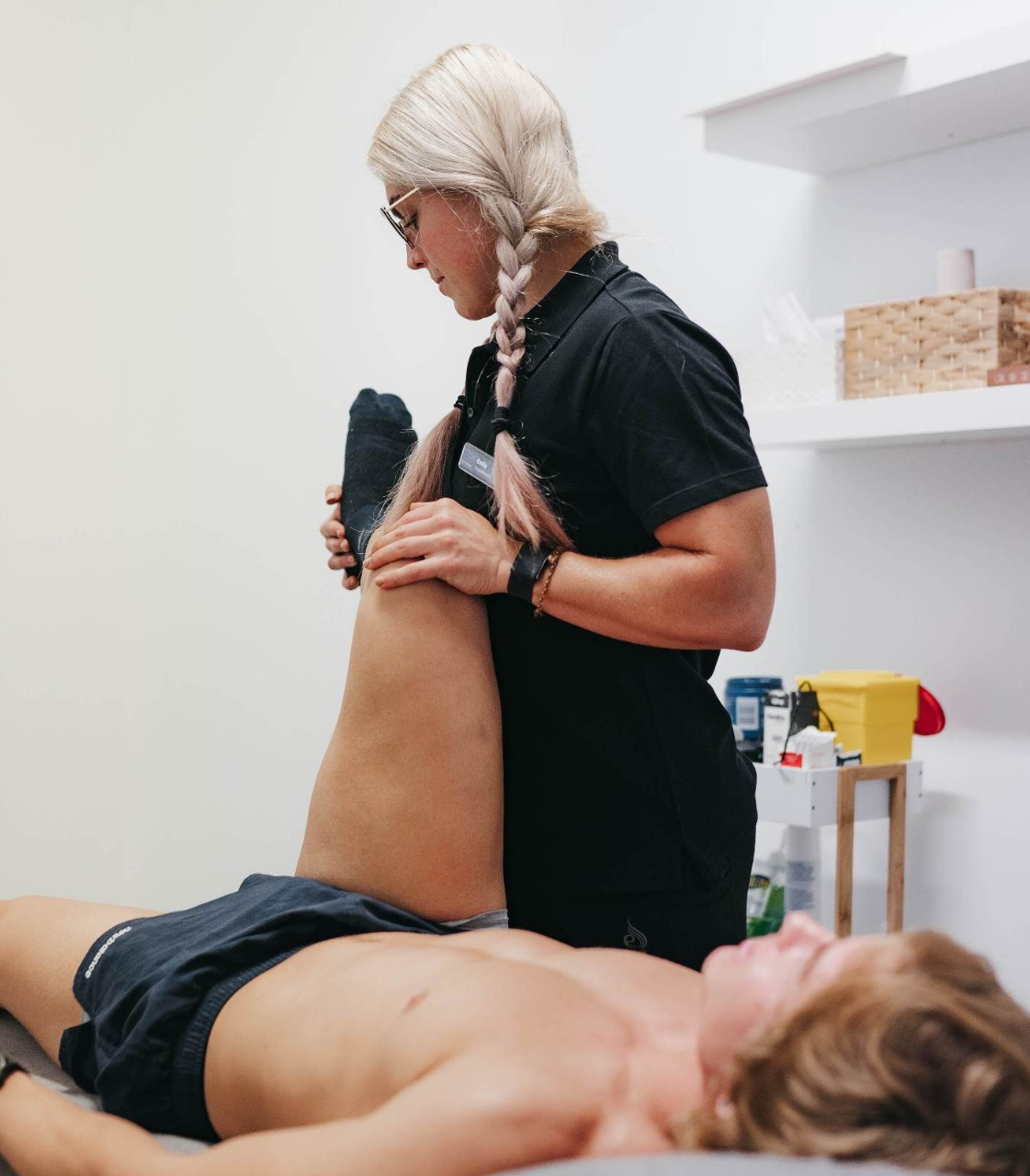
Physiotherapy is generally the recommended first-line treatment for hip labral tears and is effective for the vast majority of people — many of whom avoid surgery entirely with a well-structured conservative program.
Hands-on treatment in the early stages focuses on reducing pain, improving hip joint mobility, and addressing soft tissue restrictions in the hip flexors, gluteals, and lumbar spine. Joint mobilisation, dry needling, and soft tissue techniques help restore comfortable movement and reduce the protective muscle guarding that commonly develops around a painful hip.
Load management is established from the outset. We identify the activities and movement patterns provoking your symptoms and help you modify these while keeping you as active as possible. For most people this means modifying rather than stopping activity entirely.
Bracing & strapping is occasionally used in the early stages — particularly taping techniques that support hip positioning and reduce the range into which impingement and labral stress occur during daily activities and sport.
Progressive hip strengthening is the cornerstone of labral tear management. Building strength through the gluteals, deep hip rotators, and hip abductors reduces the compressive and shear forces on the labrum and improves the dynamic control of the femoral head within the socket. We progress loading carefully from basic activation work through to functional and sport-specific demands.
Movement retraining addresses the faulty movement patterns — in squatting, running, pivoting, and sport-specific tasks — that place excessive stress on the labrum. Correcting these patterns is essential for long-term symptom management and preventing recurrence whether or not surgery is ultimately required.
How Massage & Myotherapy Can Help
The hip flexors, gluteals, deep hip rotators, piriformis, and lumbar musculature commonly develop significant tension and trigger points in people with hip labral tears — both as a contributing factor and a consequence of altered movement and muscle guarding. Remedial massage and myotherapy targeting these areas can meaningfully reduce pain, improve hip mobility, and support more normal movement mechanics.
Cupping to the gluteal and hip flexor region can be particularly effective for easing deep tissue tension that is difficult to address with standard massage alone. Trigger point therapy to the TFL, piriformis, iliopsoas, and adductors can provide significant relief for people whose pain has a strong muscular component alongside the structural labral pathology.
Our massage and myotherapy team works closely with your physio to ensure soft tissue treatment directly supports your rehabilitation program at every stage.
When to Seek Further Medical Advice
Hip labral tears are generally manageable with physiotherapy, but some presentations require prompt medical review:
- Sudden severe hip pain after a fall, impact, or twisting injury — possible fracture or significant acute soft tissue injury requiring urgent imaging
- Complete locking of the hip joint — may indicate a loose body or displaced labral fragment requiring urgent specialist assessment
- Significant hip or groin pain in a child or adolescent — should always be assessed medically to rule out conditions such as Perthes disease or slipped capital femoral epiphysis
- Constant severe pain unrelated to activity — particularly if accompanied by night pain, unexplained weight loss, or feeling generally unwell
- Symptoms that are worsening despite consistent, well-managed physiotherapy over eight to twelve weeks — warrants MRI review and orthopaedic referral to discuss surgical options
- If any of these apply, we will identify them at your initial assessment and refer you promptly to the appropriate medical professional.
Progosis
The majority of people with hip labral tears respond well to conservative physiotherapy and do not require surgery. Evidence suggests that structured rehabilitation produces outcomes comparable to surgery for most presentations — with the advantage of avoiding surgical risk and recovery time.
- Mild to moderate tears — three to six months of structured physiotherapy typically produces meaningful and lasting improvement
- More complex or longstanding presentations — six to twelve months, particularly where significant FAI, dysplasia, or secondary muscle dysfunction is present
- Surgical cases — hip arthroscopy with labral repair or reconstruction is considered when conservative management has been thorough and symptoms remain significantly limiting. Post-operative rehabilitation typically takes six to nine months for full recovery
Early intervention, a well-structured strengthening program, and correction of the underlying mechanical factors driving labral stress are the key predictors of a good long-term outcome — with or without surgery.
Why Choose Active Balance Physio & Wellness?
Physio-led integrated care
Physio, massage, myo & rehab under one roof
Individualised treatment plans
Friendly, caring team focused on results
Convenient Adelaide location
After-hours appointments available
Frequently Asked Questions
Q: Do I need an MRI to diagnose a labral tear? MRI — particularly MRI arthrogram, where contrast dye is injected into the joint — is the gold standard imaging investigation for labral tears. However, it is not always required before starting treatment. A thorough clinical assessment can strongly suggest labral involvement, and physiotherapy can begin based on clinical findings. MRI is most important when surgery is being considered or when the diagnosis is genuinely uncertain.
Q: Will I need surgery? Most people with hip labral tears do not need surgery. Conservative physiotherapy is effective for the majority of presentations. Hip arthroscopy is considered when symptoms have not responded adequately to a thorough course of physiotherapy — typically at least three to six months of well-structured rehabilitation. The decision should always be made jointly with your physio, GP, and orthopaedic surgeon.
Q: Is a labral tear the same as FAI? They are closely related but not the same. FAI refers to abnormal bony contact in the hip joint — it is one of the most common causes of labral tears. A labral tear is the structural injury that results from that contact. Many people have both, and addressing the FAI component is an important part of managing labral tear symptoms conservatively.
Q: Can a labral tear heal on its own? The labrum has a limited blood supply, particularly in its inner portion, which means true healing of a full thickness tear is unlikely without surgical intervention. However, many people achieve excellent pain relief and function through physiotherapy without the tear itself needing to heal — by offloading the labrum through improved muscle strength and movement control. Symptom resolution and structural healing are not the same thing.
Q: Can I keep exercising with a labral tear? In most cases yes, with appropriate modification. Completely stopping activity is rarely necessary and often counterproductive. Your physio will help you identify which activities to continue, which to modify, and which to temporarily avoid while your hip strengthens and symptoms settle.
✅Private Health Rebates
✅Same Week Appointments
✅Experienced Team
✅Onsite Parking
Ready to Get Your Hip Sorted?
Don't let hip pain keep you out of sport, the gym, or the activities you love. With the right treatment and a structured strengthening program, most people with hip labral tears make an excellent recovery.
Book an appointment with our experienced physiotherapy team today.