
Osgood-Schlatter's Disease Treatment Adelaide
Knee Pain Physiotherapy St Marys
Knee pain just below the kneecap in a young athlete? Osgood-Schlatter's is one of the most common causes of adolescent knee pain — and one that responds very well to the right physiotherapy approach. At Active Balance we combine hands-on treatment with a structured load management program so your young athlete can stay active, recover well, and get back to full training without setbacks.
osgood schlatter's disease Treatment in Adelaide
What Is Osgood Schlatter's Disease?
Osgood-Schlatter's disease is a common overuse condition affecting the tibial tubercle - the bony prominence just below the kneecap where the patellar tendon attaches to the shinbone. Despite its name, it is not a "disease" in the traditional sense; it is a traction apophysitis, meaning it is caused by repetitive tensile stress on a growth plate that is not yet fully developed.
During adolescent growth spurts, bones grow faster than the surrounding soft tissues. This creates increased tension in the quadriceps muscle group, which pulls powerfully on the patellar tendon and its attachment point at the tibial tubercle. In skeletally immature adolescents, this growth plate (apophysis) is vulnerable to repetitive stress — particularly during activities involving running, jumping, and rapid changes of direction. Over time, this traction leads to inflammation, micro-avulsion, and a characteristic bony prominence at the tibial tubercle.
Osgood-Schlatter's is self-limiting, meaning it will resolve once the growth plates fuse, typically by late adolescence. However, that can mean months or even years of discomfort if not properly managed. The right physiotherapy approach allows most young athletes to continue training, reduce pain, and prevent the condition from derailing their development.
Who does it Affect?
Osgood-Schlatter's is one of the most common musculoskeletal conditions seen in active adolescents. It is particularly prevalent in:
- Boys aged 10–15 and girls aged 8–13 — corresponding to peak growth spurts, which occur earlier in girls
- Young athletes involved in high-impact or high-volume sports — football, basketball, netball, gymnastics, athletics, and soccer are among the most common
- Adolescents who have recently increased their training load — a growth spurt combined with a jump in training volume is a classic trigger
- Those with reduced hamstring and quadriceps flexibility — tight muscles amplify traction forces at the tibial tubercle
- Young athletes with biomechanical factors including increased quadriceps angle, foot pronation, or hip weakness — all of which alter lower limb load distribution
- Both knees are affected in approximately 20–30% of cases
Contributing Factors & Causes
- Rapid adolescent growth — increased bone length without corresponding muscle-tendon adaptation raises tensile load at the tibial apophysis
- High training volume or a recent spike in activity — particularly sports involving repetitive jumping, sprinting, or kicking
- Tight quadriceps and hip flexors — increased resting tension amplifies traction forces at the tibial tubercle
- Weak gluteal and hip stabiliser muscles — altering lower limb mechanics and increasing demand on the quadriceps
- Reduced ankle dorsiflexion — driving compensatory changes in knee loading patterns
- Foot overpronation — altering tibial rotation and knee stress distribution
- Inadequate recovery between training sessions — insufficient time for the apophysis to adapt to loading
- Playing on hard surfaces — increasing ground reaction forces transmitted through the lower limb
- Sports with asymmetric loading — such as kicking sports where one dominant limb is loaded repetitively
Symptoms & Signs
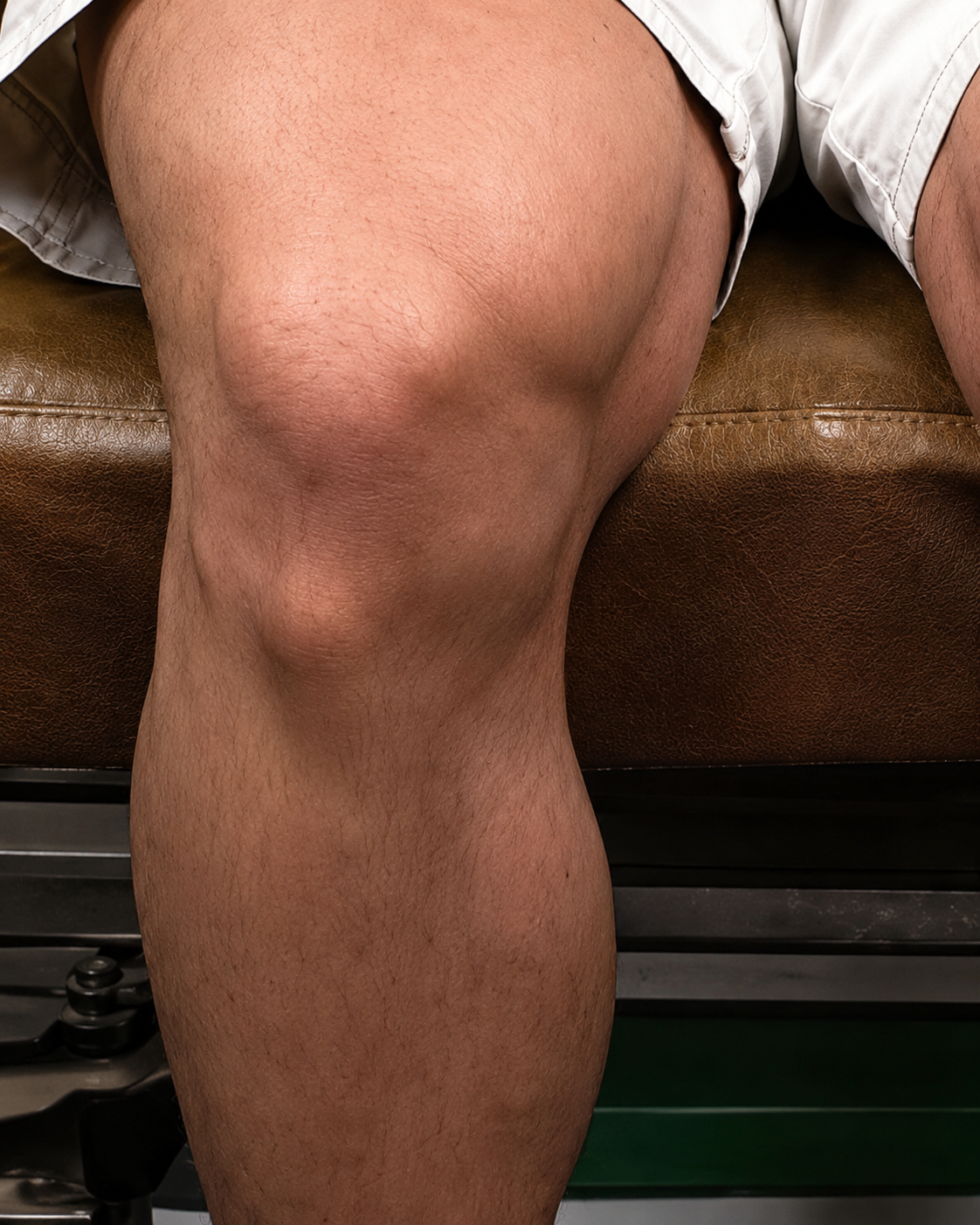
- Pain and tenderness directly over the tibial tubercle — the bony bump just below the kneecap — which is the hallmark feature of Osgood-Schlatter's
- Swelling or visible enlargement of the tibial tubercle — the bony prominence may become noticeably larger and remain so even after the condition resolves
- Pain that worsens with activity — particularly running, jumping, squatting, stair climbing, and kneeling
- Pain that eases with rest — a characteristic feature that distinguishes it from more serious pathology
- Stiffness and aching after a period of rest following activity — the "warm-up and re-cool" pattern is common
- Tightness in the quadriceps and patellar tendon region
- Reduced knee flexion range due to pain or quadriceps tightness
- Symptoms that fluctuate with training load — flare-ups during periods of heavy sport and improvement during school holidays or rest
How Physiotherapy Can Help Osgood-Schlatter's
Hands-on treatment targeting the quadriceps, hip flexors, iliotibial band, and patellar tendon can directly reduce the tensile load being transmitted to the tibial tubercle. Soft tissue release of tight quadriceps and hip flexors is particularly effective in reducing traction forces. Patellofemoral joint mobilisation helps optimise kneecap tracking and reduce secondary pain. Dry needling to the quadriceps and patellar tendon region can further help manage pain and facilitate tissue recovery.
How Massage & Myotherapy Can Help
Tightness in the quadriceps, hip flexors, and iliotibial band is one of the primary drivers of increased traction force at the tibial tubercle, and is a consistent finding in young athletes with Osgood-Schlatter's. Regular soft tissue treatment targeting these areas can meaningfully reduce the load being transmitted through the patellar tendon, complementing the physiotherapy program and supporting more consistent training.
Remedial massage and myotherapy to the quadriceps and anterior hip musculature is particularly valuable in the acute phase when pain is limiting the ability to stretch effectively. Myofascial release along the quadriceps and iliotibial band can help restore tissue extensibility, reduce reactive tightness after sport, and improve recovery between sessions.
Our massage and myotherapy team works closely with your physio to ensure soft tissue treatment is coordinated with the load management and rehabilitation program.
When to Seek Further Medical Advice
Osgood-Schlatter's is generally a safe and manageable condition, but some presentations warrant prompt medical assessment:
- Acute severe pain following a specific incident — a tibial tubercle avulsion fracture can occur under extreme load and requires urgent imaging
- Significant knee swelling, warmth, or redness — may indicate an inflammatory or infectious process requiring medical review
- Night pain or pain at rest unrelated to activity — pain that is not clearly load-related should be investigated to rule out other causes
- Locking, giving way, or other mechanical symptoms — not typical features of Osgood-Schlatter's and warrant further assessment
- Pain that is diffuse or poorly localised around the knee — may indicate a different condition such as Sinding-Larsen-Johansson syndrome, patellar tendinopathy, or intra-articular pathology
- No meaningful improvement after six to eight weeks of consistent management — warrants imaging and a review of the management approach
- If any of these features are present, we will identify them at your initial assessment and refer promptly to the appropriate medical professional.
Progosis
Osgood-Schlatter's has an excellent long-term prognosis. It is a self-limiting condition that resolves once the tibial apophysis fuses, typically between the ages of 16 and 19. With appropriate management, the vast majority of young athletes can continue participating in sport throughout the course of the condition — and most recover without lasting functional limitations.
- Mild cases — good symptom control within four to eight weeks with load modification, stretching, and taping. Sport continues with minor adjustments.
- Moderate cases — eight to sixteen weeks of structured management typically required, with ongoing monitoring through growth spurts. Full sport participation generally maintained with modification.
- Severe or recurrent cases — may require more significant training reduction during peak growth and symptom flares. Imaging to assess apophyseal integrity. Occasional orthopaedic referral in cases with large avulsion fragments.
A visible bony lump at the tibial tubercle is common and often persists into adulthood, even after full symptomatic resolution. This is cosmetic only and does not affect function or sporting capacity in the vast majority of individuals.
The biggest predictor of a good outcome is appropriate load management early — continuing to push through significant pain without modification tends to prolong the condition and increase the risk of a more serious flare. If your child has been struggling with knee pain for months without a clear management plan, it's worth getting the right advice sooner rather than later.
Why Choose Active Balance Physio & Wellness?
Physio-led integrated care
Physio, massage, myo & rehab under one roof
Individualised treatment plans
Friendly, caring team focused on results
Convenient Adelaide location
After-hours appointments available
Frequently Asked Questions
Q: Does my child need to stop all sport? In most cases, no. Complete rest is rarely necessary and often counterproductive — both for the athlete's physical development and their wellbeing. The goal is to find a training level that keeps symptoms manageable while allowing continued participation. Your physio will identify what modifications are needed so your child can keep playing as much as possible.
Q: How long will it take to resolve? Osgood-Schlatter's is a growth-related condition, which means it typically persists until the tibial growth plate fuses — usually by the mid-to-late teenage years. That doesn't mean your child will be in significant pain throughout. With the right management, most young athletes achieve good symptom control relatively quickly, with flare-ups managed through load adjustment. The condition often settles meaningfully within a few months, with residual sensitivity during growth spurts.
Q: Can my child play through the pain? To a degree — but with guidance. Mild discomfort during activity is generally acceptable, provided symptoms settle within 24 hours of finishing. Significant pain during sport, limping, or symptoms that linger for days afterward are signs the current load is too high. Your physio will give you clear guidelines on how to interpret and respond to symptoms and adjust training accordingly.
Q: Do we need an X-ray or scan? Not always. Osgood-Schlatter's is primarily a clinical diagnosis based on age, symptoms, and physical assessment findings. Imaging is not routinely required to begin treatment. X-ray may be useful in severe or persistent cases, or if the presentation is atypical. Your physio will advise if imaging is indicated.
Q: Will the bony lump go away? The inflammation and tenderness will resolve as growth slows and the apophysis fuses. A residual bony prominence at the tibial tubercle, however, is common and often permanent. In the vast majority of cases this is entirely cosmetic and causes no functional issues in adult life.
Q: Is Osgood-Schlatter's the same as growing pains? No. Growing pains is a general term for diffuse nocturnal aching in younger children and is not related to a specific structure. Osgood-Schlatter's is a distinct condition with a specific mechanism — traction on the tibial apophysis — and a characteristic location. The pain is always localised to the tibial tubercle and is directly related to loading, not nocturnal and diffuse.
Related articles:
Growing pains or something else? What parents need to know about Osgood-Schlatter and Sever's
Why "Just Resting" an Injury Usually Isn't Enough
✅Private Health Rebates
✅Same Week Appointments
✅Experienced Team
✅Onsite Parking
Don't let knee pain sideline your child through their best sporting years. With the right management, most young athletes with Osgood-Schlatter's can stay active, train well, and recover without long-term issues.
Book an appointment with our experienced physios today.