
Patellar Tendinopathy Treatment Adelaide
Knee Pain Physiotherapy St Marys
Pain at the front of your knee just below the kneecap, particularly with jumping, running, or squatting?
Patellar tendinopathy is one of the most common overuse injuries in active adults and athletes, and one of the most frustrating to manage without the right approach.
At Active Balance we combine hands-on treatment to settle your pain with a structured progressive loading program to rebuild tendon strength and get you back to full performance.
patellar tendinopathy Treatment in Adelaide
What Is Patellar Tendinopathy?
Patellar tendinopathy — sometimes called jumper's knee — is a condition involving degeneration and dysfunction of the patellar tendon, which connects the kneecap (patella) to the shinbone (tibia) and plays a critical role in transmitting the forces generated by the quadriceps during jumping, running, squatting, and kicking.
Like all tendinopathies, the underlying issue is tendon overload rather than simple inflammation. When the cumulative stress placed on the tendon exceeds its capacity to recover, the normal tendon structure breaks down — a process called tendinosis — leading to pain, stiffness, and reduced function. This distinction matters because it directly influences how the condition should be treated — progressive loading, not rest, is the most effective long-term solution.
Who does it Affect?
Patellar tendinopathy is most prevalent in athletes involved in sports with high jumping and landing demands — hence the nickname jumper's knee. It is particularly common in:
- Basketball, volleyball, and netball players — where repeated jumping and landing are central to the sport
- Runners — particularly those who have recently increased their training volume or intensity
- Football and AFL players — high-speed sprinting and kicking place significant demand on the patellar tendon
- Gym-goers and weightlifters — particularly those performing heavy squats, leg press, or plyometric training
- Active adults who have recently returned to sport or significantly increased their activity levels
It affects men more commonly than women and is most prevalent in the 15–40 age group, though it can develop at any age in sufficiently active individuals. It can affect one or both knees simultaneously.
Contributing Factors & Causes
- Rapid increase in training load — the most common driver, particularly a sudden spike in jumping or running volume
- Hard training surfaces — concrete and synthetic surfaces increase tendon load compared to grass or sprung floors
- Quadriceps and hip weakness — inadequate strength increases the relative stress on the patellar tendon with each repetition
- Poor landing mechanics — excessive forward lean, knee valgus, or stiff-legged landing patterns increase tendon load
- Reduced ankle dorsiflexion — limited ankle mobility is strongly associated with patellar tendinopathy in jumping athletes
- Training errors — insufficient recovery between high-load sessions
- Previous tendon injury — a tendon that has been previously overloaded has reduced capacity and is more susceptible to recurrence
- General health factors — obesity, metabolic conditions, and some medications (particularly fluoroquinolone antibiotics) are associated with poorer tendon health
Symptoms & Signs
- Pain at the inferior pole of the patella — the bony point at the bottom of the kneecap — which is the most classic location
- Pain that is worse with jumping, landing, running, squatting, and going up or down stairs
- Stiffness and aching at the start of activity that may warm up and ease — then return after exercise
- Localised tenderness directly on the tendon when pressed
- Pain after prolonged sitting with the knee bent — sometimes called the "theatre sign"
- In more advanced cases, pain that becomes present throughout activity and doesn't settle as readily after
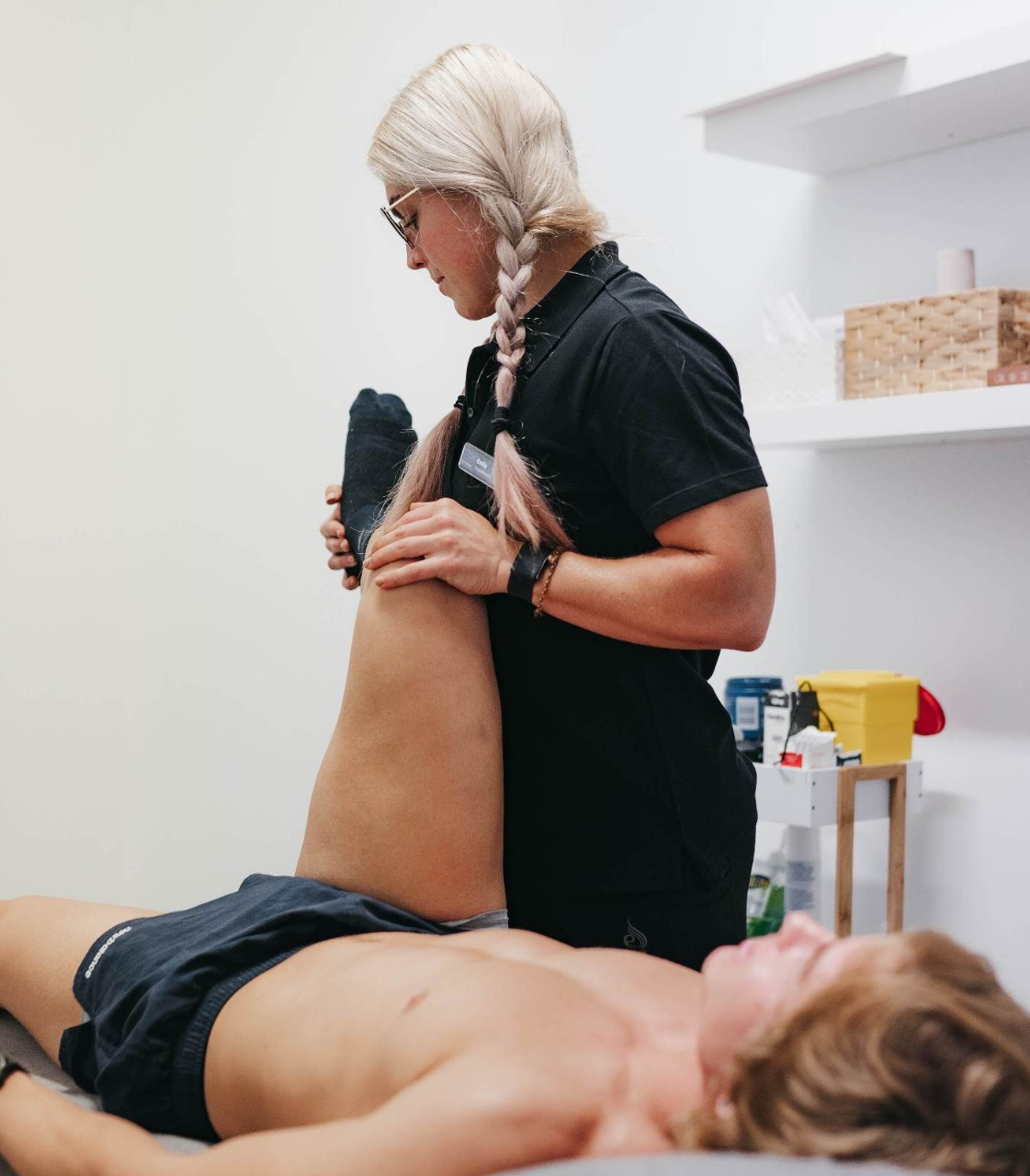
How Physiotherapy Can Help Hip Impingement
Physiotherapy is generally the gold standard treatment for patellar tendinopathy. The evidence is clear that a progressive loading program produces the best long-term outcomes — and our approach is built around exactly that.
Hands-on treatment in the early stages uses a combination of soft tissue techniques, joint mobilisation of the knee and hip, and dry needling to reduce pain and improve tissue extensibility. This gets you comfortable enough to begin loading the tendon effectively — which is where lasting recovery comes from.
Load management is established immediately. We calculate a safe starting point for tendon loading based on your symptom irritability and identify which training activities to continue, modify, or temporarily avoid. Getting this balance right from the start is critical — too much rest allows the tendon to decondition, too much load drives further degeneration.
Bracing & strapping can provide useful short-term symptom relief. A patellar tendon strap worn during activity helps offload the tendon insertion and reduce pain during training and daily tasks. Patellar taping techniques can also be used to alter patellar mechanics and reduce tendon stress. Your physio will advise what's appropriate for your presentation.
Progressive tendon loading is the cornerstone of recovery. We follow an evidence-based progression starting with isometric quadriceps exercises — which have an immediate pain-relieving effect — before advancing through isotonic strengthening, heavy slow resistance training, and ultimately energy storage and release exercises that replicate the demands of your sport. Each stage is progressed based on your symptom response, not a fixed timeline.
Movement retraining addresses the biomechanical factors driving tendon overload — landing mechanics, squatting pattern, running gait, and hip and ankle control. Correcting these patterns is essential for returning to sport safely and preventing recurrence.
How Massage & Myotherapy Can Help
Significant tension commonly develops in the quadriceps, ITB, hip flexors, and calf musculature in people with patellar tendinopathy — both as a contributing factor and a consequence of altered loading patterns. Remedial massage and myotherapy targeting these areas reduces the muscular tension that increases compressive and tensile load at the patellar tendon.
Trigger point therapy to the quadriceps — particularly the vastus lateralis and rectus femoris — can produce meaningful reductions in anterior knee pain and improve knee mechanics. Cupping & soft tissue work to the quadriceps and ITB can be particularly effective for releasing deep tissue tension that restricts knee movement and loads the tendon. Our massage and myotherapy team works closely with your physio to ensure soft tissue treatment is coordinated and complementary at every stage of your recovery.
When to Seek Further Medical Advice
Patellar tendinopathy is a benign condition that responds well to physiotherapy in the vast majority of cases. However some presentations warrant prompt medical review:
- Sudden severe knee pain during activity — particularly if accompanied by a pop, significant swelling, or inability to straighten the knee, which may indicate a patellar tendon rupture requiring urgent assessment
- Significant swelling, bruising, or deformity around the knee — may indicate a fracture or other structural injury rather than tendinopathy
- Pain that is constant, severe, and unrelated to activity — should be investigated to rule out other causes
- Night pain that wakes you from sleep — particularly if accompanied by unexplained weight loss or feeling generally unwell
- No meaningful improvement after eight to twelve weeks of consistent, well-structured physiotherapy — warrants imaging review and possible specialist referral
- If any of these apply, we will identify them at your initial assessment and refer you promptly to the appropriate medical professional.
Progosis
Patellar tendinopathy has a good prognosis with the right management, though it is one of the more stubborn tendinopathies and requires patience and consistency with a loading program.
- Mild or early cases — six to twelve weeks of structured loading typically produces good improvement
- Moderate cases — three to six months, particularly where the tendon has been symptomatic for some time or has been managed suboptimally
- Chronic or severe cases — six to twelve months or longer, particularly in high-level athletes returning to jumping sport
The biggest predictor of a poor outcome is failing to complete a full progressive loading program — particularly the heavy slow resistance and energy storage phases that are essential for returning to jumping and running sport. Many people improve with early treatment but relapse because they return to sport before tendon capacity is fully rebuilt.
Why Choose Active Balance Physio & Wellness?
Physio-led integrated care
Physio, massage, myo & rehab under one roof
Individualised treatment plans
Friendly, caring team focused on results
Convenient Adelaide location
After-hours appointments available
Frequently Asked Questions
Q: Should I stop sport completely while I recover? Not necessarily. Complete rest allows the tendon to decondition and rarely leads to lasting improvement. The goal is finding a training load that doesn't significantly aggravate your symptoms while your loading program takes effect. Your physio will help you modify your training to keep you as active as possible throughout recovery.
Q: How is patellar tendinopathy different from runner's knee? Patellar tendinopathy causes pain at the bottom of the kneecap at the tendon insertion. Runner's knee — or patellofemoral pain syndrome — causes pain around or behind the kneecap and involves different structures. Both are common overuse conditions but require different treatment approaches, which is why accurate assessment matters.
Q: Will a cortisone injection help? Evidence for cortisone injections in patellar tendinopathy is poor and some research suggests they may worsen long-term outcomes by further disrupting tendon structure. They are generally not recommended. PRP injections show more promise for stubborn cases but should always be combined with a structured loading program.
Q: Do I need a scan? Usually not to begin treatment — patellar tendinopathy is a clinical diagnosis. Ultrasound can confirm tendon degeneration and is useful if the diagnosis is uncertain or symptoms aren't responding as expected. MRI may be used if other structural pathology is suspected.
Q: I've had it for months and tried everything — can physio still help? Yes. Chronic patellar tendinopathy is very treatable with a properly structured loading program, even after months or years of symptoms. The most common reason people don't improve is that they haven't completed a full progressive loading program through all stages — particularly heavy slow resistance and plyometric loading. It's rarely too late to start.
✅Private Health Rebates
✅Same Week Appointments
✅Experienced Team
✅Onsite Parking
Ready to Get Your Hip Pain Sorted?
Don't let hip impingement keep you out of the sport, gym, or activities you love. With the right treatment and a structured strengthening program, most people with FAI make an excellent recovery.