What Actually Happens When You Sprain Your Ankle
An ankle sprain stretches or tears the ligaments on the outside of the ankle. The pain and swelling settle within a few weeks, and most people feel well enough to return to activity well before the underlying problems have been resolved.
Here's what most people don't realise: embedded within the ligaments of the ankle are specialised nerve receptors called mechanoreceptors. These receptors are responsible for proprioception — your ankle's ability to sense its position in space and respond quickly to perturbations. When the ligament is damaged, these receptors are damaged too.
When you walk on even ground, you probably won't notice. But put yourself on uneven terrain, ask your ankle to react quickly to an unexpected movement, or load it under sport-specific demands — and the deficit becomes apparent. The ankle doesn't react fast enough. It gives way.
Pain and swelling resolve relatively quickly.
Proprioception, muscle reaction time and strength take much longer to restore — and they don't restore on their own with rest. They need to be actively rehabilitated.
How Chronic Ankle Instability Develops
Chronic ankle instability develops when the deficits from an ankle sprain — reduced proprioception, calf weakness, poor balance and altered movement patterns — are never properly addressed.
The typical pattern looks like this: ankle gets rolled, it's sore for a few weeks, pain settles, activity resumes. Feels okay until the next awkward step, landing or change of direction — at which point the ankle gives way again. Another sprain. More rest. Back to activity. Repeat.
Each subsequent sprain causes further ligament damage and further proprioceptive deficit. Over time the ankle becomes progressively less stable, and people start adapting their behaviour around it — avoiding uneven ground, relying on bracing for sport, avoiding certain activities altogether.
You may have chronic ankle instability if you:
- Have a history of multiple ankle sprains on the same side
- Feel like your ankle is unreliable or likely to give way
- Have done little or no formal rehabilitation after your sprains
- Depend on bracing or strapping to feel safe during sport
- Notice stiffness or aching after loading the ankle
- Have reduced confidence on uneven ground or during cutting movements
What We Typically See in Assessment
When we assess someone with chronic ankle instability, the findings are remarkably consistent regardless of how many sprains they've had or how long the instability has been present:
- Calf weakness — the calf muscles are the primary active stabilisers of the ankle. Weakness here is almost universal in chronic ankle instability and contributes directly to the feeling of giving way.
- Reduced proprioception — balance testing on the affected side shows clear deficits compared to the unaffected side, particularly on dynamic tasks.
- Poor hip control — this one surprises people, but hip abductor and external rotator weakness allows the knee to collapse inward during landing and cutting, which changes how load is distributed through the ankle and significantly increases instability risk.
- Reduced ability to hop and land — single leg hopping and landing tasks — the movements most likely to cause a re-sprain — are often avoided or performed with clear compensation patterns.
- Fear of movement — after multiple sprains, many people develop a guarded relationship with their ankle. They move differently, they anticipate the give and they avoid loading it. This avoidance, while understandable, actually perpetuates the problem by preventing the ankle from being trained.
What Rehabilitation Actually Looks Like
The good news is that chronic ankle instability responds very well to a structured rehabilitation program. The deficits are real but they are addressable — and most people can return to full activity including high-demand sport with the right program.
Rehabilitation progresses through several phases:
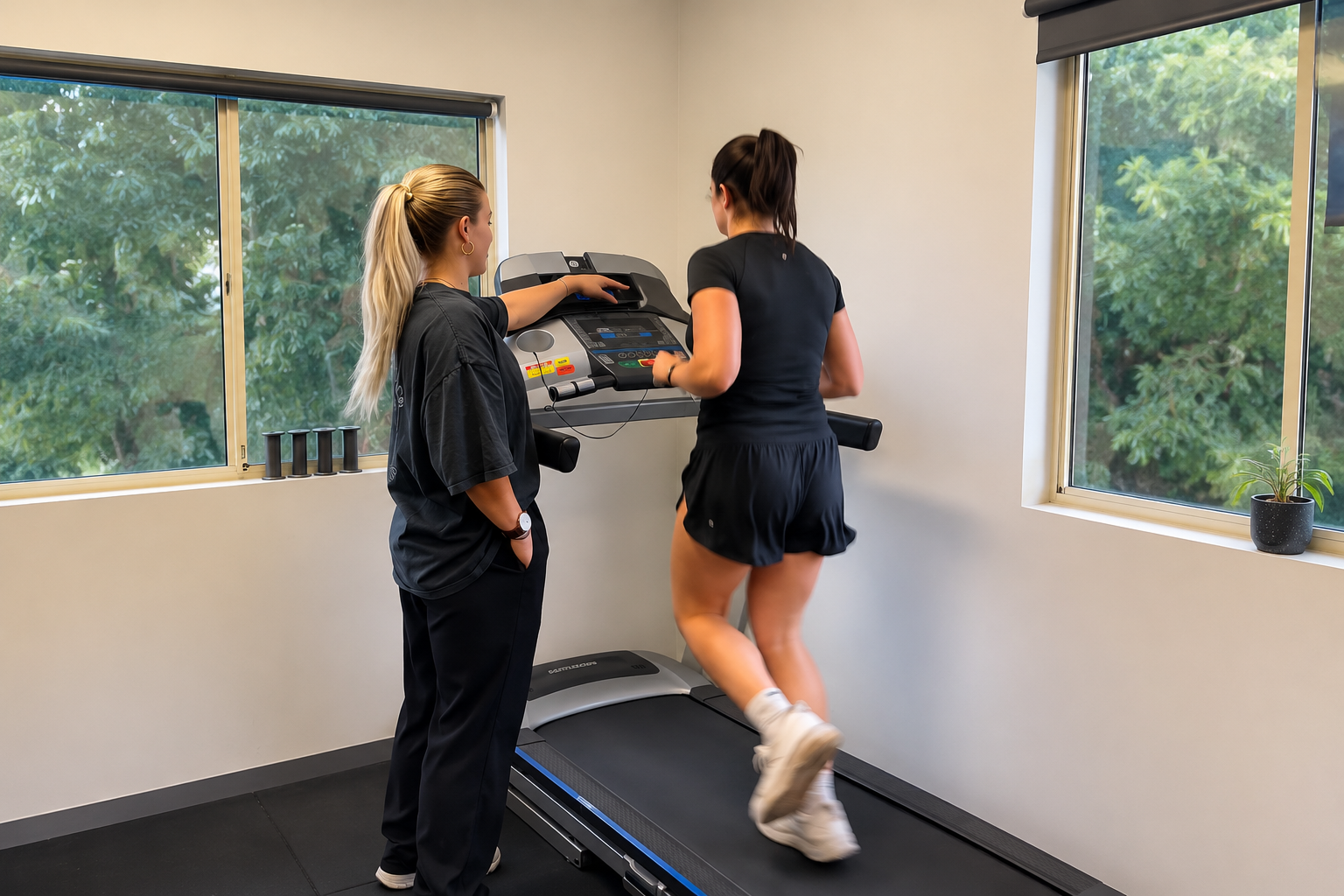
- Balance and proprioception retraining This is the foundation. Single leg balance work — starting on stable surfaces and progressing to unstable surfaces — begins retraining the nervous system's ability to sense and respond to ankle position. The goal is not just to be able to stand on one leg, but to react quickly and automatically when the ankle is challenged.
- Calf and hip strengthening Progressive calf strengthening — starting with double leg calf raises and building to single leg, weighted, and eventually explosive variations — restores the primary active stabiliser of the ankle. Hip strengthening addresses the proximal control deficit that contributes to instability during dynamic movements.
- Progressive loading and impact work Once strength and balance are restored, the rehabilitation introduces more challenging tasks — hopping, bounding, lateral movements, cutting and change of direction. This phase trains the ankle to handle the specific demands of your sport or activity.
- Bracing and taping — useful but not the answer A brace or tape job can provide support and confidence during return to sport, and is a reasonable short-term strategy while strength and proprioception are being rebuilt. But relying on a brace long-term without addressing the underlying deficits is not a solution — it's a workaround that leaves the underlying problem unaddressed.
- Return to sport testing Before returning to high-risk sport, objective testing — including single leg hop tests and balance assessment — can confirm that the ankle has the capacity to handle the demands it will face. This removes the guesswork from the return to sport decision.
Is Surgery Ever Needed?
For the vast majority of people with chronic ankle instability, surgery is not necessary. Conservative management — physiotherapy and structured rehabilitation — produces good outcomes for most presentations.
Surgery becomes a consideration when conservative management has genuinely failed after an adequate trial, when there is significant mechanical laxity that isn't responding to strengthening, or when there are associated structural issues such as osteochondral damage that require intervention.
If you've been told you might need surgery for your ankle, it's worth having a thorough physiotherapy assessment first to confirm that conservative management has been properly completed rather than just attempted briefly.
If your ankle keeps giving way and you're ready to actually fix it rather than just manage it, book online or call us on (08) 7123 4148. We can assess exactly what's driving your instability and put together a specific plan to address it.